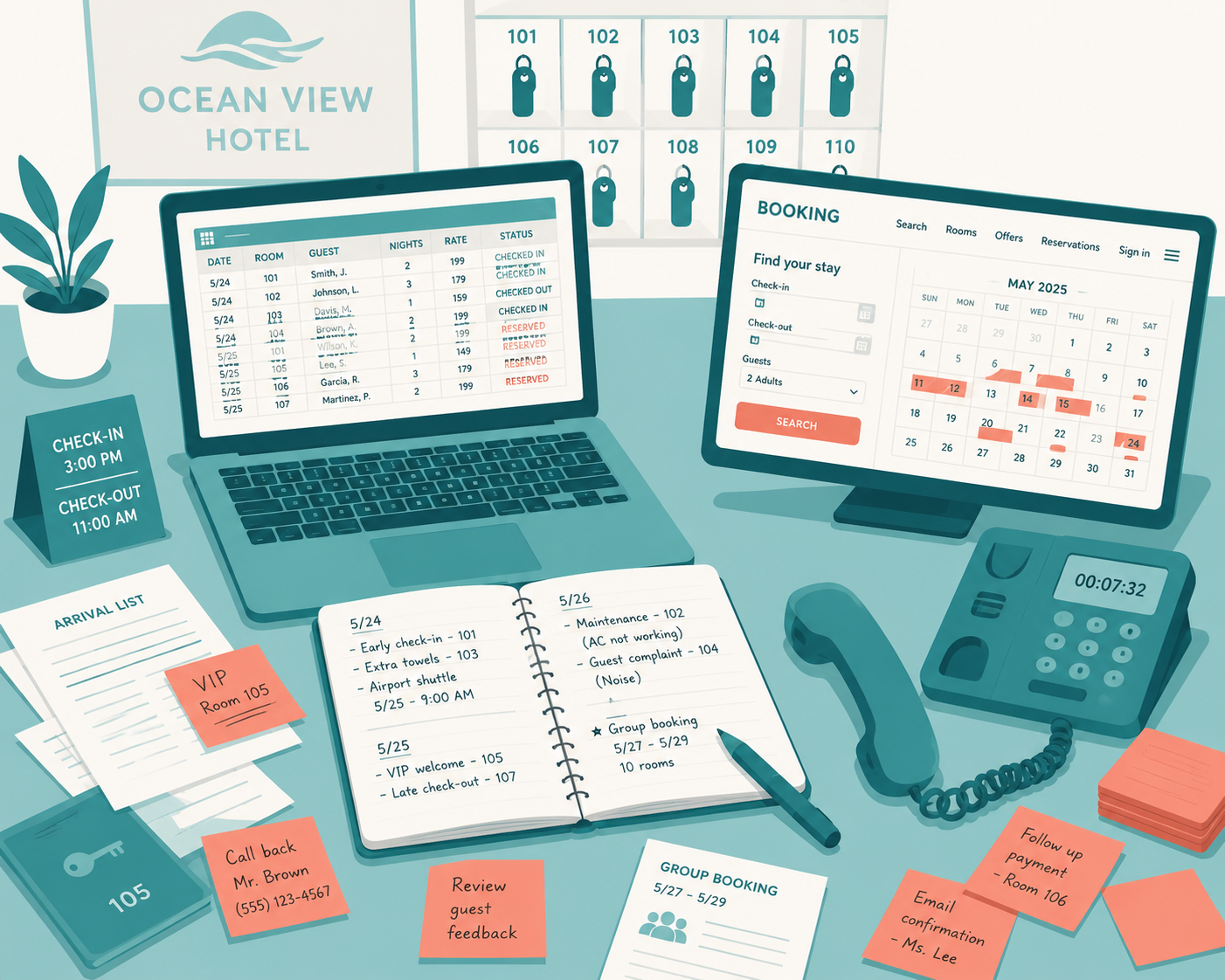
The hotel software market is crowded. A quick search returns dozens of options — each claiming to be the best PMS, the most complete, the cheapest. Yet many hoteliers end up locked into systems that are either too complex, too expensive, or simply the wrong fit for their property.
This guide cuts through the noise. Whether you run a 5-room guesthouse or a 100-room hotel, the same clear criteria apply. Here's how to choose a hotel management system you won't regret.
A hotel management system — also called a PMS (Property Management System) or hotel software — is the central platform that runs the day-to-day operation of a property. It replaces spreadsheets, paper notebooks, and scattered tools with a single place to manage reservations, guests, rooms, rates, and revenue.
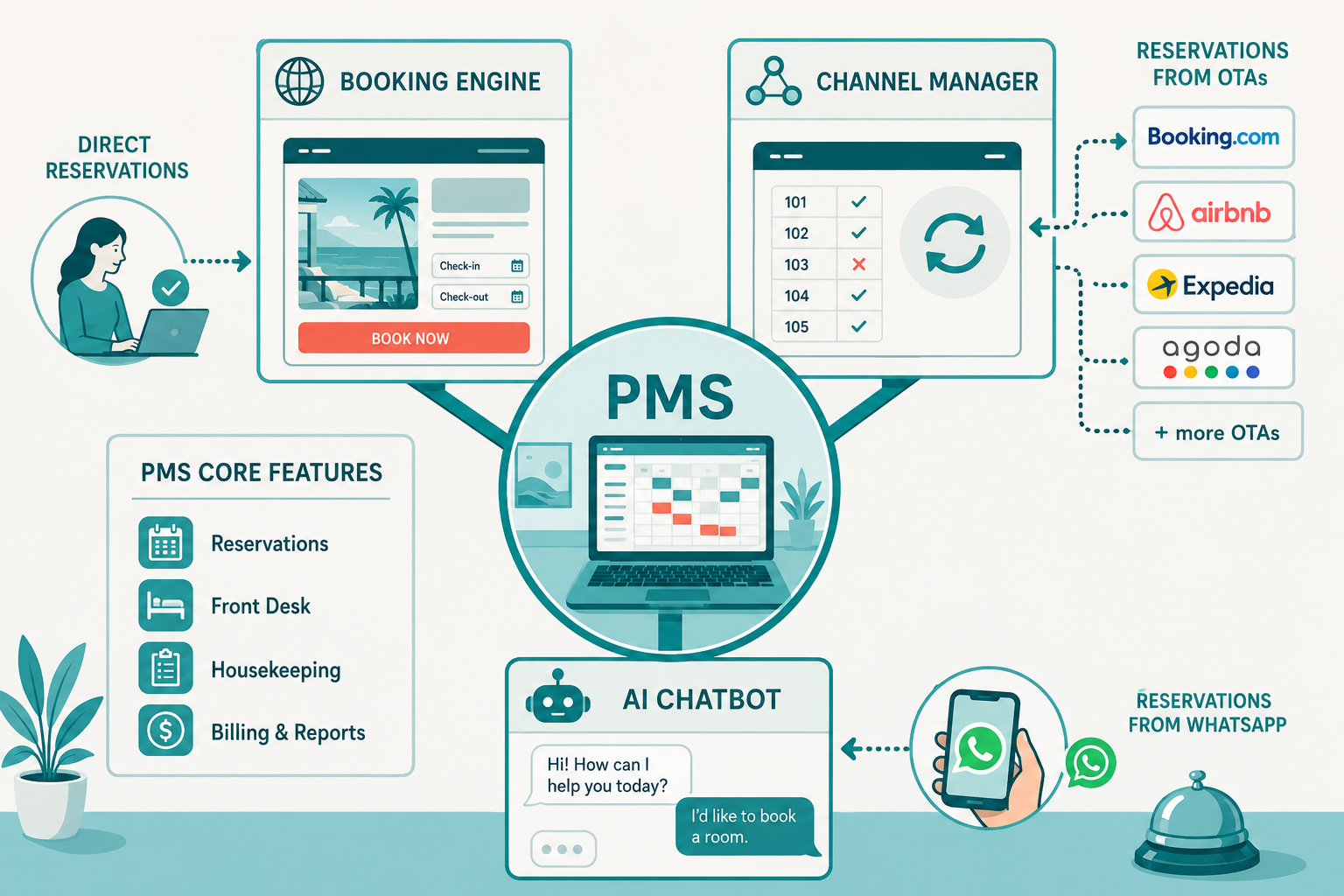
Not all hotel software includes the same features. Here's what each core module does — and why it matters for your property.
The core of any hotel software is the property management system itself. It centralizes everything that happens inside your property:
This is the foundation every other module builds on. Without a solid PMS core, add-ons like a channel manager or booking engine have nowhere to anchor to.
A booking engine is the tool that lets guests book directly on your own website — without going through Booking.com, Airbnb, or any OTA. It shows live availability, collects payment, and sends confirmation automatically.
The financial case is simple: every direct booking saves the OTA commission (typically 15–25%). A booking engine pays for itself quickly for any property that generates meaningful direct traffic.
A channel manager connects your hotel to multiple booking portals simultaneously — Booking.com, Airbnb, Expedia, and 50+ others. When a room is booked on any platform, the channel manager instantly updates availability everywhere else, preventing double bookings.
Without a channel manager, updating rates and availability across channels manually is time-consuming and error-prone. For any property listed on more than one OTA, a channel manager is essential.
An AI chatbot handles guest conversations on WhatsApp automatically — answering questions, processing reservation requests, sending payment links, and confirming bookings around the clock, in any language.
For independent hotels, this means capturing bookings that would otherwise go unanswered outside business hours, reducing the front desk workload, and offering guests the instant response they expect from modern services.
Before signing up for any system, run it through these seven questions. They apply whether you're evaluating a free tool or an enterprise platform.
Ease of use is the single most underrated criterion. A system with 200 features is worthless if your receptionist needs a manual to complete a check-in.
Sign up for a trial and try to create a reservation without reading any tutorial. Is it obvious where to go? Did you find what you needed without help? If you struggled, your staff will too — likely in a high-pressure moment with a guest standing at the front desk.
Monthly subscription is just the starting point. Watch for: per-booking fees, setup fees, training costs, mandatory add-ons, and charges for each additional user or integration.
The cheapest plan on the pricing page often becomes the most expensive when you add what you actually need. Always ask for a quote that reflects your real usage: number of rooms, number of channels, number of staff users.
If you list rooms on Booking.com, Airbnb, Expedia, or any OTA (Online Travel Agency — platforms where guests book your rooms), your PMS must sync availability and rates automatically. Manual updates are a recipe for overbooking.
Ask specifically: which booking portals are integrated, and how fast is the sync with those portals? And check whether the channel manager is included in the price or costs extra.
Hotels operate 24/7. Your software problems don't wait for business hours. Before committing, test the support: send a question via chat, call the support line, open a ticket. How fast do they respond? Is support available in your language?
Read recent reviews specifically mentioning support quality — not just star ratings. A system with great features and terrible support is a liability.
The tool that works for 8 rooms today should be able to handle 30 rooms in three years. Check whether upgrading plans is seamless, whether data migrates cleanly, and whether the paid tiers include the features you'll actually want later: revenue management, booking engine, channel manager, AI chatbot, invoicing.
Modern hotel management happens on the go. You need to check occupancy at dinner, approve a late check-in request, or close a channel from the beach. A mobile-ready interface isn't a luxury — it's a practical requirement for any owner-operator.
Any serious hotel software vendor should let you test their product with your real data before you pay. Beware of demos-only approaches where you can't enter actual reservations, or trials limited to 3 days (not enough to evaluate anything properly).
A 14-day free trial with full access to features is the minimum reasonable standard. If a vendor won't let you test it properly, ask yourself why.
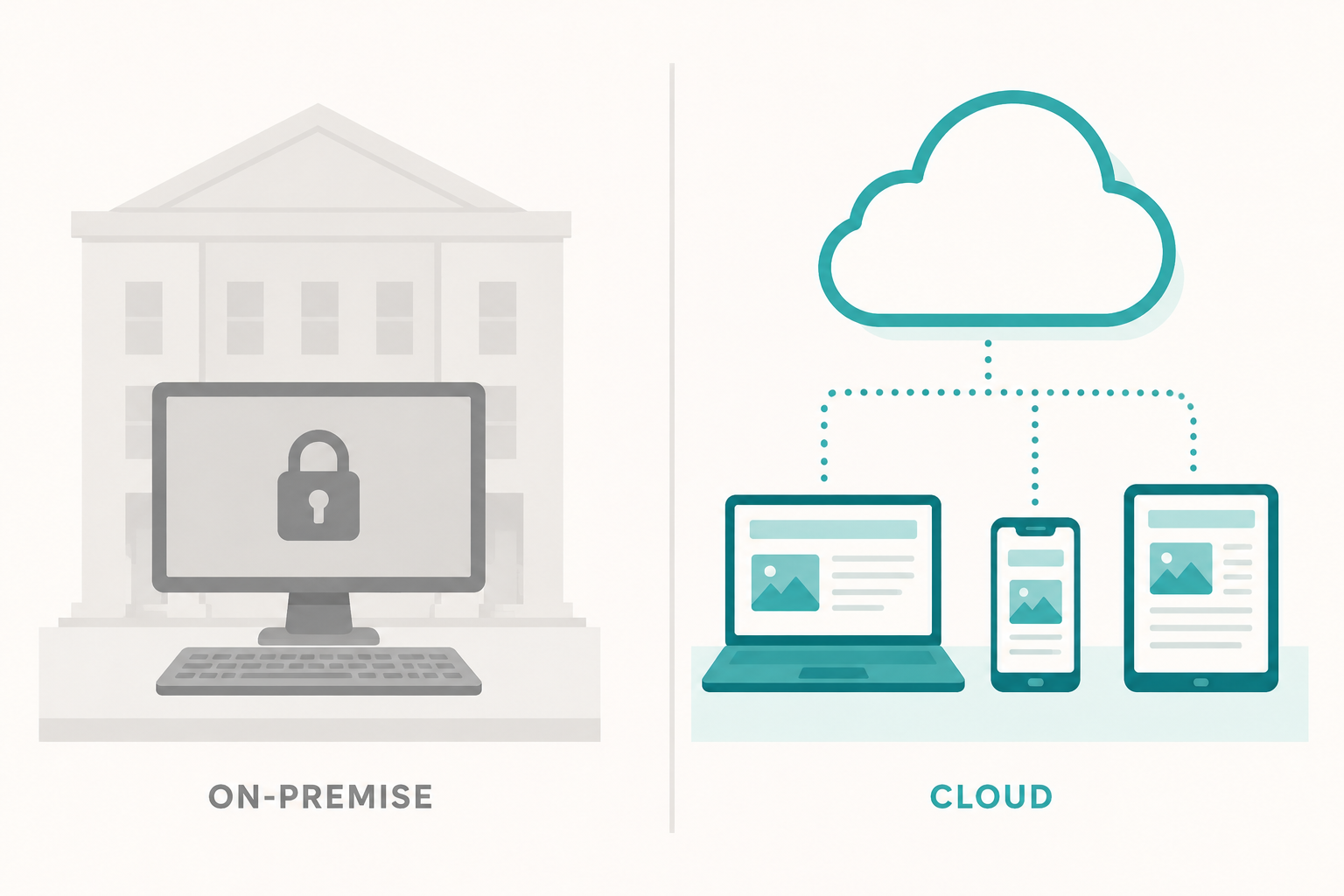
One of the first forks when choosing hotel software is where it runs. On-premise software is installed on a computer at your property; cloud (web-based) software runs on the vendor's servers and you reach it through a browser from anywhere.
For the vast majority of independent hotels, cloud wins decisively:
On-premise still makes sense in rare cases — properties with chronically unreliable internet, or specific local-data rules. But for almost everyone else, a cloud PMS removes cost and risk rather than adding it.
Traditional hotel software often forces you into a rigid all-in-one bundle: you pay for everything upfront — channel manager, booking engine, housekeeping, restaurant POS — even if you only need half of it. That's expensive and unnecessarily complex for most independent properties.
The better approach is a modular system where you start with a solid core PMS and activate only the add-ons that your operation actually requires: a channel manager when you list on OTAs, a booking engine when you want direct reservations, a WhatsApp chatbot when you want 24/7 automated guest communication. Pay for what you use — nothing more.
Start with a free core PMS: reservation calendar, guest records, and rate management. Add the channel manager when you list on OTAs, and a booking engine when you want commission-free direct bookings.
You need the full stack: channel manager syncing 50+ OTAs, a direct booking engine, multi-user access with roles, invoicing, and solid revenue and occupancy reporting.
Combine the booking engine with a WhatsApp AI chatbot to capture and confirm reservations 24/7 — automatically, in any language — without paying OTA commissions on every booking.
Your PMS is the system of record for your business — every guest, every reservation, every payment. Before you commit, make sure you stay in control of that data:
Not all software vendors are created equal. These warning signs suggest you should look elsewhere:
A PMS (Property Management System) is the central system for managing your property: reservations, check-in/check-out, room assignments, guest records, and billing. A channel manager connects your inventory to external booking platforms (Booking.com, Airbnb, Expedia) and keeps availability synchronized in real time. Most modern PMS solutions include a basic channel manager — but check what's included before assuming.
Yes — for smaller properties managing direct reservations. A well-built free plan covers the core of what a guesthouse needs: reservation calendar, guest database, rate management, and basic reporting. LodgeHog's free plan, for example, includes unlimited rooms and reservations with no time limit.
When you start listing on Booking.com, Airbnb, or other OTAs, you'll want to add a channel manager — that's typically a paid add-on, but it pays for itself immediately by preventing overbooking and saving manual update time.
A modern cloud-based PMS for a small property can be operational in a day. You set up your rooms, import or enter existing reservations, connect your channels, and you're running. Mid-size hotels typically need 1–2 weeks for full configuration and staff training. Large properties with complex integrations may need 1–3 months — but that's the exception, not the rule for most independent hotels.
Yes, if you choose your new system carefully. Before migrating, export all historical data from your current system (guest records, past and future reservations). Most modern PMS tools accept CSV imports. Future reservations are the priority — past data can often be archived externally. Plan the migration during a low-occupancy period and keep your old system accessible for 2–4 weeks as a fallback.
LodgeHog is a cloud-based, modular hotel management system built specifically for independent hoteliers and small accommodation businesses. Here's how each part maps to the criteria above.
Free forever — visual booking calendar, check-in/check-out, guest profiles, rates and reports, all from one screen.
Commission-free direct bookings on your own branded domain, synced live with your calendar.
50+ OTAs from a single dashboard, with rate and availability sync in under 5 seconds.
24/7 guest answers on WhatsApp, your website and Instagram — fewer calls, faster replies.
Issue NF-e invoices and submit the mandatory FNRH guest registration straight from the system — no copy-pasting between platforms.
The PMS core is free forever. Add the booking engine, channel manager, AI chatbot, or fiscal modules only when you need them — no bundles, no features you'll never use, no long-term contracts.
LodgeHog is built for independent hoteliers who want professional management without enterprise complexity or cost. Start with the free plan and upgrade only when you're ready. No credit card, no long-term contract.
Free software with all the essential features:
Sell on Booking.com, Airbnb & 50+ sites
Sell everywhere and on your own site
We believe in price transparency. Use our pricing calculator to estimate your subscription fee.