Back to Blog
June 8, 2026

How to Choose a Booking Engine: The Definitive Guide for Hotels

A booking engine is the single most profitable piece of technology a property can own. It turns your website into a commission-free sales channel — capturing direct reservations 24/7, with no OTA taking a cut.

But its value is decided by two things: how much commission it saves you, and how well it converts visitors into paid bookings. This guide is built around exactly that — the money and the conversion — so you choose a booking engine that grows your direct revenue instead of quietly leaking it.

What is a hotel booking engine?
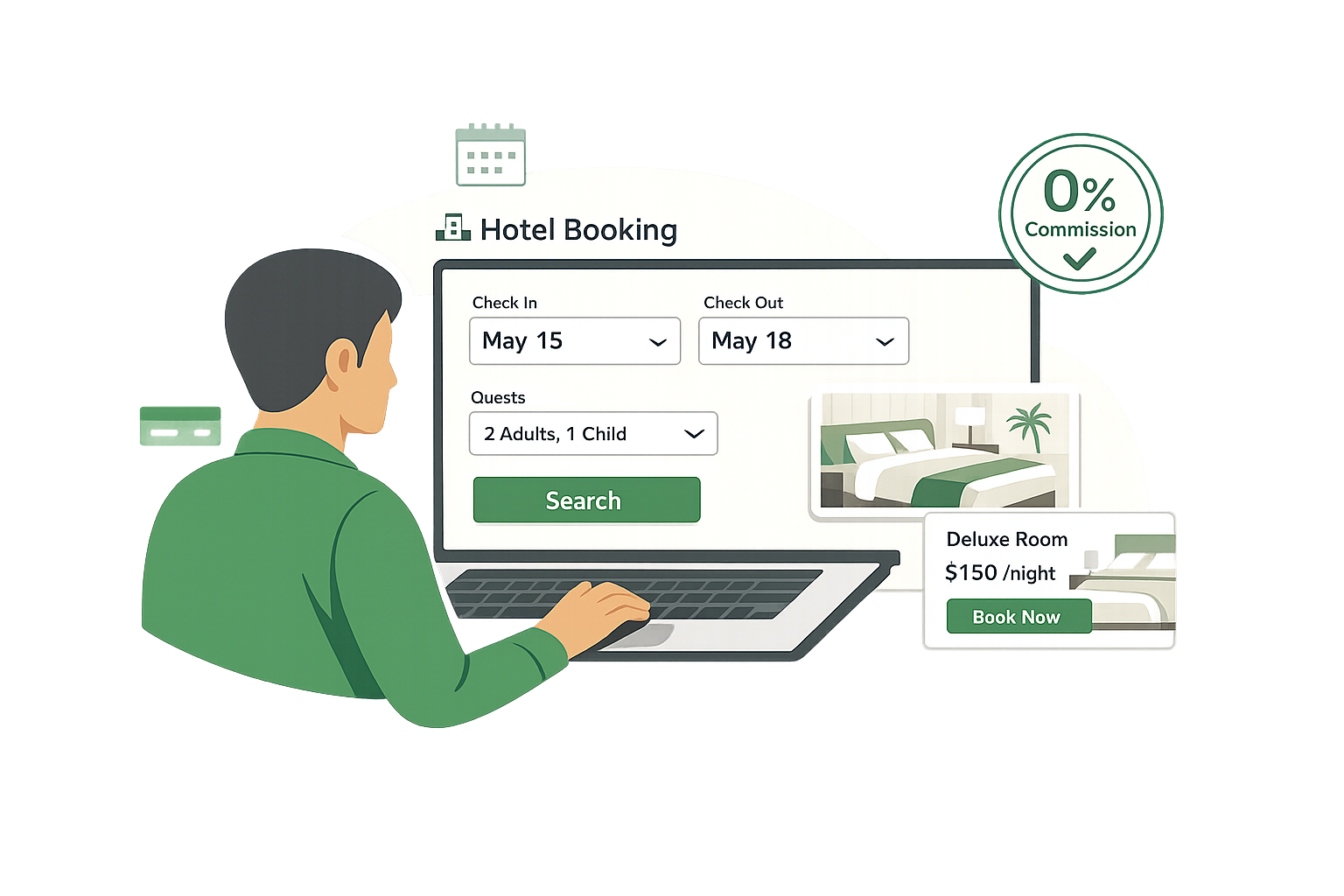
Illustration of a hotel website with a direct booking flow capturing commission-free reservations

A hotel booking engine is the software that lets guests reserve and pay for a room directly on your own website — without going through Booking.com, Airbnb, Expedia, or any other OTA (Online Travel Agency). It shows your live availability, calculates real-time pricing, collects the guest's details and payment, and confirms the reservation automatically.

In short: it is the "Book Now" button for your hotel. The channel manager fills rooms through OTAs; the booking engine captures the bookings you keep in full. The two work best side by side — but only the booking engine earns commission-free revenue.
The real ROI: every direct booking dodges a commission

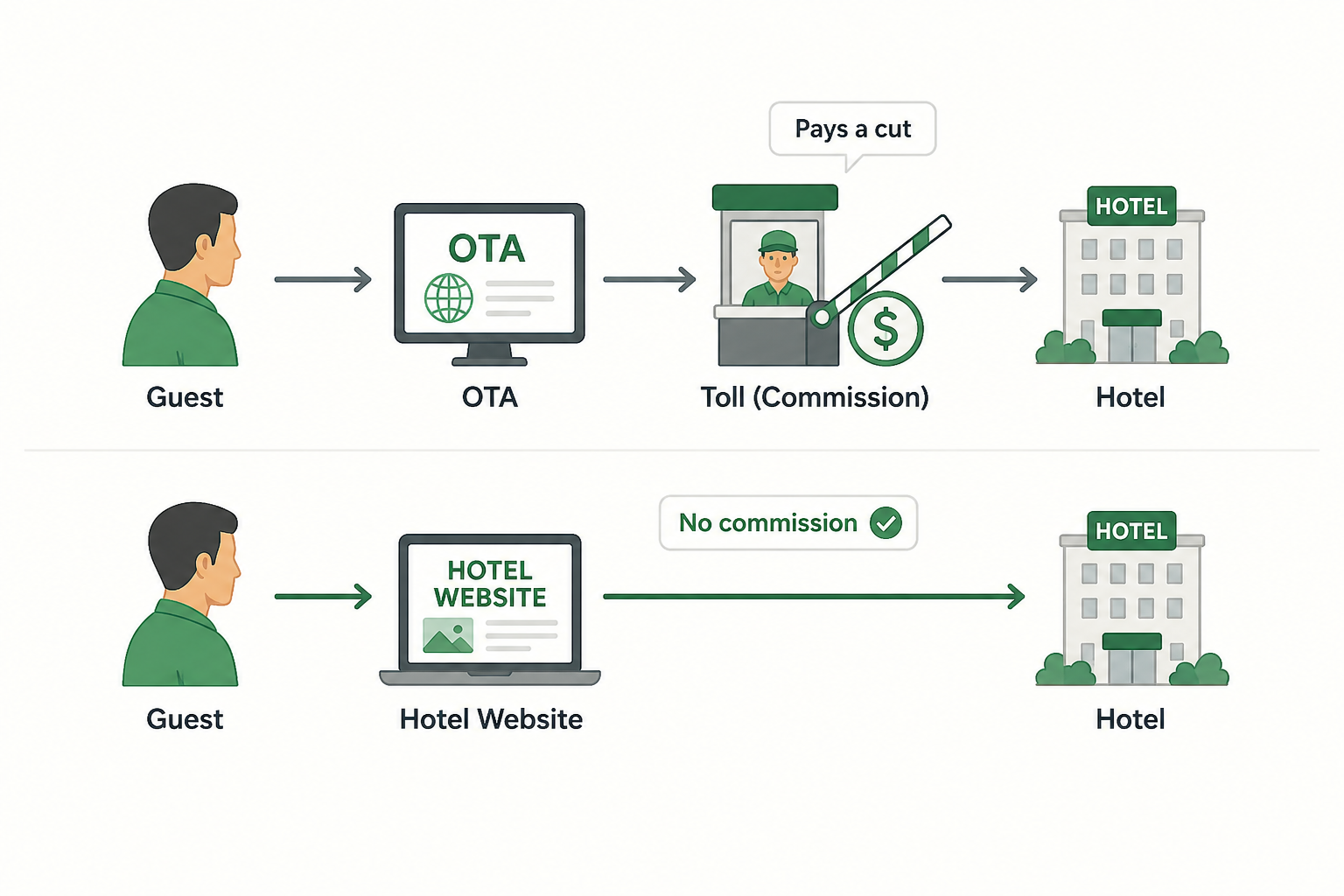
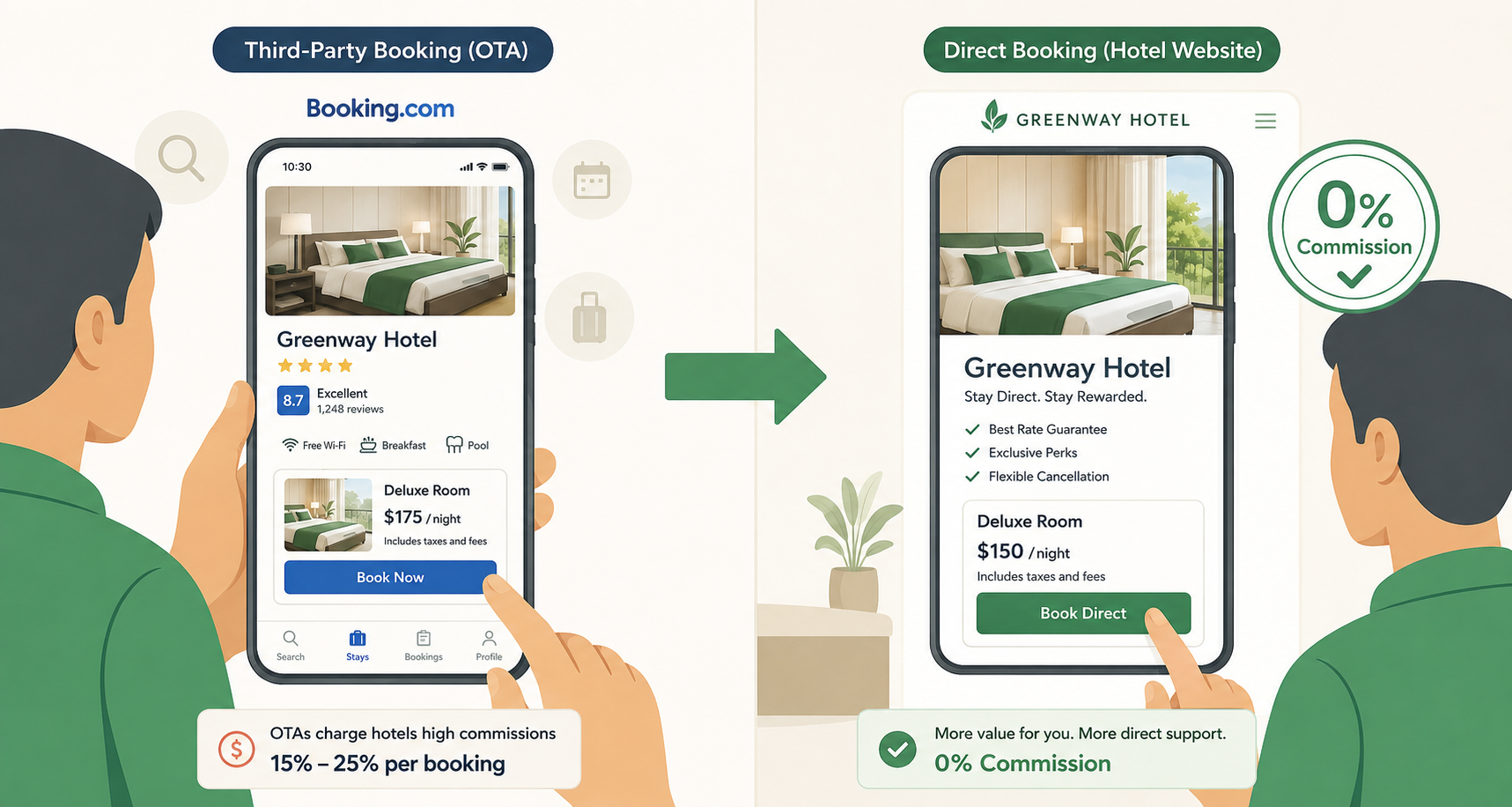
The math is simple and unforgiving. OTAs charge 15% to 25% — sometimes 30% — on every reservation they send you. A property doing $2,000 a month through OTAs at 20% commission hands $4,800 a year to a third party.

A direct booking engine flips that equation: every reservation through your own site carries zero commission, you keep 100% of the revenue, and you own the guest relationship and their contact data. That is why it pays for itself faster than anything else in your stack — it converts traffic you already pay to attract (your website, social media, Google) into bookings you keep in full.

So when you evaluate a booking engine, judge it on two numbers: the commission it removes, and the share of visitors it turns into bookings. Everything below ladders up to those two.

What is your OTA commission bill?

Calculate how much you pay in OTA commissions
20%
Per month
Per year

A direct booking engine removes this cost entirely.

What to look for: the features that actually matter

Ignore long feature checklists. For a booking engine, only a handful of capabilities move the needle on revenue. These are the ones to evaluate.

Real-time sync with your PMS and channel manager

Availability must be pulled live from your property management system and stay consistent across every OTA. The moment a room sells anywhere, it should vanish from your direct page — no manual updates, no overbooking. An engine that connects to a channel manager keeps direct and OTA inventory in one calendar.

Flexible, secure payments

Look for secure credit card processing, the local methods your guests actually use (PIX in Brazil, for example), and a pay-at-property option. More ways to pay means more completed bookings — and you should know exactly who holds the funds and when they reach your account.

Your brand, your domain

The page should run on your own subdomain (e.g. booking.yourhotel.com) with your logo, your colours and an automatic SSL certificate. Guests who never feel they left your website trust the checkout more — and trust converts.

Multilingual and multi-currency

If you attract international travellers, the engine should display in their language and quote in a currency they recognise. A guest who cannot read the checkout will not finish it.

Metasearch and analytics integration

A modern engine plugs into Google Hotel Ads and metasearch, and lets you drop in Google Analytics and a Meta pixel so you can measure cost per direct booking and prove the return. If you cannot track it, you cannot grow it.

The #1 trap: per-booking fees

The biggest mistake when choosing a booking engine is accepting a per-booking fee. A "1.5% commission" or "$2 per reservation" looks trivial on the pricing page — until your direct channel grows and you realise you built a second OTA that takes a cut of your best, hardest-won bookings.

Always choose a flat monthly fee. It aligns the vendor with you: you both win when you sell more, and your cost stays predictable no matter how successful your direct channel becomes.

The conversion checklist

Saving commission only matters if visitors actually book. A booking engine's real job is conversion — and most lost bookings die from friction, not price. Test any engine against this checklist, on a phone, as if you were a guest in a hurry.

Effortless on mobile

More than half of travel searches happen on a phone. If the flow isn't fast and thumb-friendly on mobile, those guests leave for an OTA app that is. Always test the full journey on a phone first.

Few clicks, no forced account

Count the clicks from dates to confirmation — fewer is better. And never force guests to create an account to book. Mandatory sign-up is one of the most common reasons a checkout is abandoned.

Honest, all-in pricing

Show taxes and fees upfront, per night, with no surprises at the final step. Sticker shock at checkout is a conversion killer — and the transparency builds the trust that wins the booking.

Gentle urgency and scarcity

Honest cues — "only 2 rooms left", "5 people viewing these dates" — nudge undecided guests to commit. The key word is honest: fake scarcity erodes the trust you just built.

Abandonment recovery

Most people who start a booking don't finish it. An engine that captures the email early and sends an automated reminder recovers bookings that would otherwise be lost for good.

Visible trust and security signals

An SSL padlock, recognised payment logos and a clear cancellation policy reassure guests at the exact moment they hand over a card. Small signals, measurable lift.

Get found, then convert direct: the billboard effect

OTAs aren't the enemy — they're a discovery channel. Studies of the "billboard effect" show that travellers routinely find a hotel on Booking.com, then visit the property's own website to book. A strong booking engine is what captures that intent instead of sending it back to the OTA.

The winning strategy is layered: use OTAs to get discovered, then convert guests direct — and keep them direct on every repeat stay. To make it work, your engine should:

  • Compete on metasearch. Show your direct rate alongside the OTAs on Google Hotel Ads, so the cheapest, commission-free option is visible at the moment of choice.
  • Reward booking direct. A best-rate guarantee or a small direct-only perk gives guests a concrete reason to skip the OTA.
  • Measure everything. With analytics and a pixel in place, you can see cost per direct booking and reinvest in what works.

The right fit for your property

Guesthouses & B&Bs

Prioritise a dead-simple mobile checkout and a flat fee. Every direct booking commission-free, zero technical setup, an SSL page on your own domain.

Hotels (20–100 rooms)

Multi-room checkout, multilingual and multi-currency support, metasearch, and tight channel-manager integration so direct and OTA inventory never collide.

Vacation rentals

Flexible date ranges, clear per-night pricing with taxes upfront, and a checkout that handles longer stays and multiple units gracefully.

Mistakes to avoid

Even experienced hoteliers fall into these traps:

  • Choosing on price alone. A cheap engine with a clunky checkout converts fewer guests — the "savings" cost you bookings.
  • Testing only on desktop. You'll miss the mobile experience where most guests actually book.
  • Treating it as standalone. Disconnected from your calendar and channel manager, an engine creates overbooking and double work.
  • Giving away your guest data. With a true direct engine the guest is yours — for remarketing, loyalty and repeat stays.

Frequently asked questions about booking engines

Add a commission-free booking engine to your own website, make sure your direct rate is visible on metasearch like Google Hotel Ads, give guests a reason to book direct (a best-rate guarantee or a small perk), and keep the checkout fast and mobile-friendly. Over time you shift bookings from commissioned OTA channels to your own site, where you keep 100% of the revenue.

A booking engine takes reservations directly on your own website, commission-free. A channel manager distributes your availability and rates across external OTAs and keeps them in sync. They solve different problems and work best together: the channel manager fills rooms through OTAs, the booking engine captures the bookings you keep in full.

The best value is a predictable flat monthly fee with no per-booking charge. Avoid engines that take a percentage of each reservation — that cost grows as your direct channel grows. Many quality booking engines also offer a free trial so you can measure the return before paying anything.

Yes. A modern booking engine runs on its own subdomain (like booking.yourhotel.com) and links seamlessly from your existing site, or embeds into it. You don't rebuild your website — you just add the "Book Now" path that converts visitors into direct, commission-free reservations.

Why LodgeHog is the right booking engine for your property

LodgeHog is built for independent hoteliers and hosts who want professional direct sales without enterprise cost or complexity. Measured against the two numbers that matter — commission saved and visitors converted — it's designed to win on both, and it never takes a cut of your direct bookings.

Maximum commission saved — 0%, flat fee

Every direct booking goes straight to you. You pay a predictable flat fee, never a per-reservation cut, so the more you sell the more you keep. The engine pays for itself with the first few commission-free bookings.

Built to convert

A fast, mobile-first checkout with multi-room booking, taxes shown upfront and no forced account creation — designed to turn lookers into paid bookings instead of losing them to friction.

One calendar, never oversold

Availability syncs live from your LodgeHog PMS and stays consistent across Booking.com, Airbnb and Expedia through the built-in channel manager — so direct and OTA inventory never collide.

Your brand, your domain, automatic SSL

Guests book at booking.yourhotel.com with your logo and colours, on a page secured automatically — a seamless experience that builds the trust which lifts conversion.

Pay any way — credit card, PIX, on arrival

Credit card payments, PIX with a configurable discount in Brazil, and a pay-at-property option. Confirmation emails reach the guest and your team automatically.

Want to see it in action? Try the booking engine on a live demo hotel.

See a live demo

Try it free, keep every commission you save

Start with a 14-day free trial — set up your rooms, take a real test booking, and see the guest experience for yourself. No credit card, no long-term contract, no per-booking fees. Ever.

See the LodgeHog booking engine in action

Turn your website into a commission-free booking machine

Join independent properties already keeping 100% of their direct revenue with LodgeHog. Start your free 14-day trial — no credit card, no commitment.

Our plans

Basic, no cost
$0/month forever

Free software with all the essential features:

  • Reservation calendar
  • Unlimited reservations and guests
  • Rate plans: automate room pricing
  • Reservations items: track room expenses
Professional
Starting from $34.90 /month

Access all our powerful modules designed to help your property grow.

  • Channel Manager: Sync availability and rates with 50+ travel sites (Booking.com, Airbnb, etc)
  • Booking Engine: Get commission-free bookings directly through your website
  • Priority support

We believe in price transparency. Use our pricing calculator to estimate your subscription fee.